PNHRSPNHRSPNHRS

  • 2023 COMMITTEES
  • NUHRA
  • REGIONS
  • OPPORTUNITIES
  • News
  • About PNHRS
    • Organizational Chart
    • PNHRS
    • Objectives
    • Vision I Mission I Core Values
    • Strategy Map
    • History
    • Implementing agencies
    • Downloads
    • Gallery
    • TWC Update
    • About PNHRS Law
R&D Updates
24 September 2014
Hits: 14369

Local plant shows promise in treating anxiety in a study

  • Print
  • Email

Herbal plant known locally as busikad (Kyllinga brevifolia) may ease anxiety according to a study done by Pharmacy students at the San Pedro College in Davao City.

Busikad is a local medicinal plant grown locally across the country. Traditionally processed into tea, many local communities use busikad for its sedative property.

Laboratory examinations done by the students found huge amount of kaemferol in busikad. Kaemferol is a plant compound known to have antianxiety properties.

Researchers gave busikad leaves processed into capsules to laboratory mice that were subjected into various stressful games and activities. The stress-inducing activities on the mice elicited behavioural changes known to be signs of high level of anxiety such as increased stretching postures, grooming, freezing, and inhibition to explore open spaces, among others.

Comparing busikad’s effectiveness with that of Diazepam, a well-known brand of antianxiety medication, researchers found that doses of busikad capsule are as effective as the branded drug in relieving anxiety in mice. Research result showed that mice given with busikad capsules stopped showing behavioural signs of high level of anxiety at the same rate as those given with Diazepam.

Researchers discussed the importance of drug discovery and development in native Philippine plants, such as the busikad. They explained that with increasing cost of manufactured drugs, it is time to engage in finding alternative solution in local plants.

The study, entitled, “The Anxiolytic Activity of Kaemferol Fraction from Busikad (Kyllinga brevifolia) Leaves in Capsule Formation,” won third prize at the recently concluded Gruppo Medica Awards during the 8th Philippine National Health Research System (PNHRS) week celebration on August 12-14, 2014 in Cebu City.

R&D Updates
23 January 2014
Hits: 4229

Call for Abstract Submission - Poster and Oral Presentation at 16th UPM-NIH Anniversary and 12th University Science and Technology Week

  • Print
  • Email

University of the Philippines Manila – National Institutes of Health (UPM-NIH) invites abstract submission for oral or poster presentation in the 16th UPM-NIH Anniversary celebration and the 12th University Science and Technology week.

Submission of abstracts must be through the Newborn Screening Reference Center via email to This email address is being protected from spambots. You need JavaScript enabled to view it. attention to Ms. Marian. Deadline of submission is on 22 January 2014.

Ms. Mae Anne D. Reyes
R&D Updates
14 May 2013
Hits: 5060

EVHRDC members attend 31st PCHRD anniversary

  • Print
  • Email


Dr. Romuladez at the PCHRD 31st Anniversary.


EVHRDC members attended the 31st PCHRD Anniversary celebrations held at the Sofitel Philippine Plaza, CCP Complex, Metro Manila last March 18, 2013. The one day event was focused on the theme "People at the Center of Health and Health Research" with former Health Secretary Dr. Alfredo G. Romualdez,Jr., as the keynote speaker. To welcome the guests, Dr. Jaime C. Montoya, PCHRD Executive Director, started thanking everyone who attended the ceremonies and to all partners who have strived hard in achieving the goals of the council and the health research system as a whole. He also happily announced that the Philippines will be hosting the forthcoming "2014 Global Forum for Health Research".

A message was given by Secretary Mario G. Montejo, DOST Secretary, where he congratulated PCHRD on its 31st year of unwavering efforts to develop the health research system. He mentioned some initiatives of DOST on health. He focused on gadgets with its application accessible through the internet. On of this is the RX Box, which allows consultation through the net where doctors in the hinter barangay could seek assistance from doctor specialists through email or through texting. Another message was delivered by Secretary Enrique T. Ona, DOH Secretary, who stressed on the sustainability of the program "Kalusugang Pangkalahatan or Universal Health Care". He stressed that it is important to gather evidences of success as these are crucial in policy making. Furthermore, he stressed that the Philippines can learn from best practices in other countries and with some modifications apply these learnings. On of the new initiatives towards mobilizing funds for research was done by downloading these funds to PCHRD who managed the funds. Another DOH initiative is the establishment of a Health Research Hub at DOH currently chaired by Dr. Ernesto Domingo. This will hopefully capacitate DOH staff to conduct research and eventually manage its own research funds to the fullest.

The keynote message was given by the 1st Executive Director of PCHRD, Dr. Alberto G. Romualdez. He walked through the history of PCHRD which started with 5 brains who formulated the health research agenda with bias on human beings. He was delighted of the many initiatives done by PCHRD through the years just to move research forward. He also acknowledged the presence of the Academician Gelia Castillo (who was supposedly the one who would have delivered the keynote address but preferred to just be a reactor to the different topics lined up for the day). He ended his message by congratulating the men and women of PCHRD for the countless accomplishments of the council sustaining the efforts in health R&D.

The Panel discussion that followed were on: 1) People's Health: Listening and translating Health Needs to Research Actions; 2) Research Actions: Improving research utilization by increasing research publishing productivity and International Visibility; and 3) New paradigms and global trends in research publications: how Philippine research benefits.

The activity was attended by Health Research Consortium Members, PNHRS Members, SUCs, National Government Agencies Representatives, Private Organizations and Private Individuals.

Jose Martin Punzalan
R&D Updates
14 May 2013
Hits: 4893

Recognition of trailblazing efforts in medical research and clinical innovation

  • Print
  • Email

Medical researchers can now look forward to getting recognized for their work with the launch of the Geminiano T. de Ocampo Visionary Awards for Medical Research. Launched by the National Academy of Science and Technology (NAST) last November 8, 2012 at the Hyatt Hotel Grand Casino, the award seeks to recognize clinician researchers who have created the vision for medical research in the country through their outstanding work in medical research. It also aims to recognize those who have pioneered the trail for medical innovations and health research development.

The award is given in honor of the national scientist in the field of Opthalmology and the father of modern Philippine ophthalmology Dr. Geminiano de Ocampo, who himself was a visionary man who realized the future of medicine in the country through his groundbreaking and pioneering efforts in clinical practice and in research.

Candidates can be nominated by individuals, scientific and technological societies, professional societies or association, research institutes, universities and colleges.

Qualifications include:
1. Natural born citizens of the Philippines
2. Graduate of Medicine in an accredited and duly recognized school or college of medicine
3. Remarkable track record as a clinician practicing in the Philippines
4. Proven track record and accomplishment in medical research
5. No proven administrative case or case of moral turpitude

Nominations will be screened by the NAST secretariat and will be evaluated by a board of judges. The selected awardee will receive a gold medal, a plaque and a Php 100,000 cash prize.

In 1952, Dr. de Ocampo established the de Ocampo hospital, the first eye hospital in the Philippines. He was also the first Filipino to design a corneal dissector in 1956, and was the first Filipino to perform the first successful corneal transplant.

The award is made possible with the endowment of the de Ocampo family and will be administered by the NAST Health Sciences Division. It will be given biennially and will take place during the birth anniversary of Dr. de Ocampo, on September 16th of the year.

Nomination forms are available for download at the NAST website: www. nast.ph, or from the NAST secretariat, at the 3rd level, Science Heritage Building, DOST Compound, Bicutan, Taguig City.


From http://region7.healthresearch.ph/index.php?option=com_content&view=article&id=43:recognition-of-trailblazing-efforts-in-medical-research-and-clinical-innovation&catid=1:latest-news&Itemid=6

Date 24 April 2013 14:40

Activities
16 November 2016
Hits: 3327

Central Visayas Consortium holds health research conference; emphasizes importance of communication in health research

  • Print
  • Email

TALAMBAN, CEBU CITY- As part of the 2016 Central Visayas Health Research and Innovation Conference, communicators including writers, journalists, communication professors, videographers, and bloggers from Cebu met for the first time in a meeting of health research communicators last Thursday at University of San Carlos Talamban Campus.
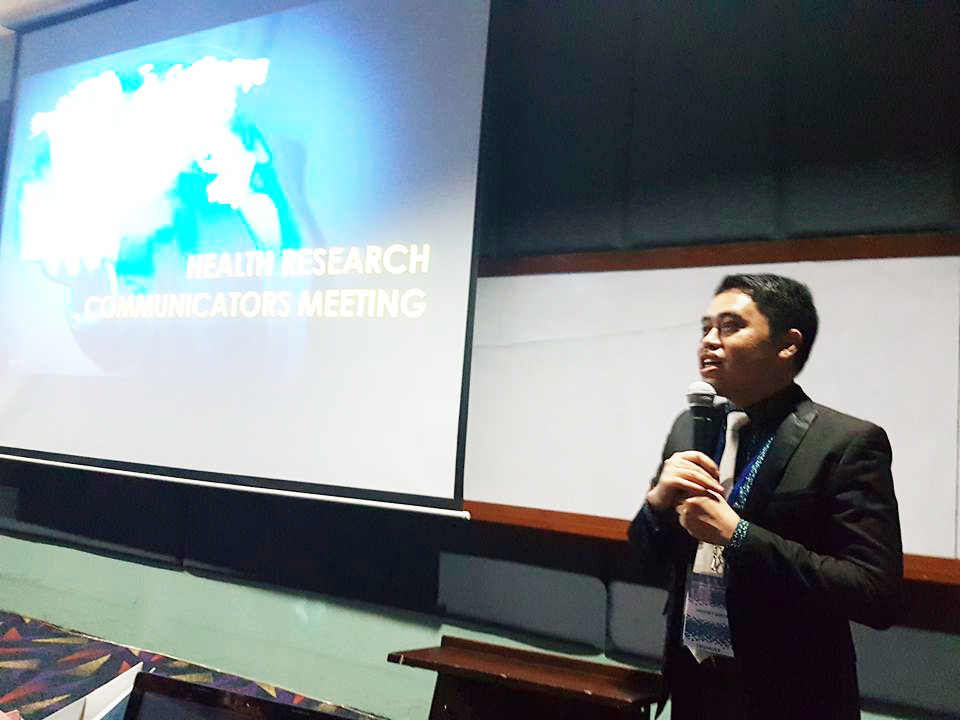

The meeting aims to gather communicators from the region to form SHARE, an initiative of the Philippine National Health Research System (PNHRS) to reach more stakeholders.

SHARE is a community of health research communicators who believes in the power of communication to share health research stories, advocacies, local and national initiatives. The community will support PNHRS and the Philippine Council for Health Research and Development (PCHRD) in communicating and translating research to benefit health research stakeholders.

During the meeting, Dr. Laurence Garcia, Central Visayas Consortium for Health Research and Development (CVCHRD) on Research Information and Utilization Chair, also presented the plan of the region in establishing their network of health research communicators.

Among their planned initiatives are the use of broadcast media and quad media to enable interactive information-sharing, Youtube to communicate challenging health researches, and capacity-building workshops to capacitate members.

“The community of health research communicators [SHARE] will help improve the dissemination of health research results in the country,” Dr. Garcia emphasized.

For communicators who are interested to join SHARE, you may contact Ms. Ladylove Baurile at This email address is being protected from spambots. You need JavaScript enabled to view it. or 837-0031. You can also visit www.healthresearch.ph for more information. ■

  1. Corporate Social Responsibility expert shares ways to engage stakeholders in health research
  2. WHO scientist to speak at PCHRD 36th yr celebration
  3. Agapay project develops robotic arm prototype for stroke patient rehab
  4. DLSU student develops robotic arm for stroke rehab

Page 53 of 59

  • Start
  • «
  • 48
  • 49
  • 50
  • 51
  • 52
  • 53
  • 54
  • 55
  • 56
  • 57
  • »
  • End

fb tw


feedback
PLEASE RATE YOUR EXPERIENCE IN USING THIS WEBSITE

Your rating

no rate selected


email is required

email is invalid

affiliation is required

affiliation is required

PCHRD LOGO small
Republic of the Philippines
Department of Science and Technology
Philippine Council for Health Research and Development
 
2/f Titanium Building, DOST MIRDC Compound
Gen. Santos Ave., Bicutan, Taguig City, 1631, Philippines
  • NUHRA
  • REGIONS
  • OPPORTUNITIES
  • News
  • About PNHRS
    • Organizational Chart
    • PNHRS
    • Objectives
    • Vision I Mission I Core Values
    • Strategy Map
    • History
    • Implementing agencies
    • Downloads
    • Gallery
    • TWC Update
    • About PNHRS Law